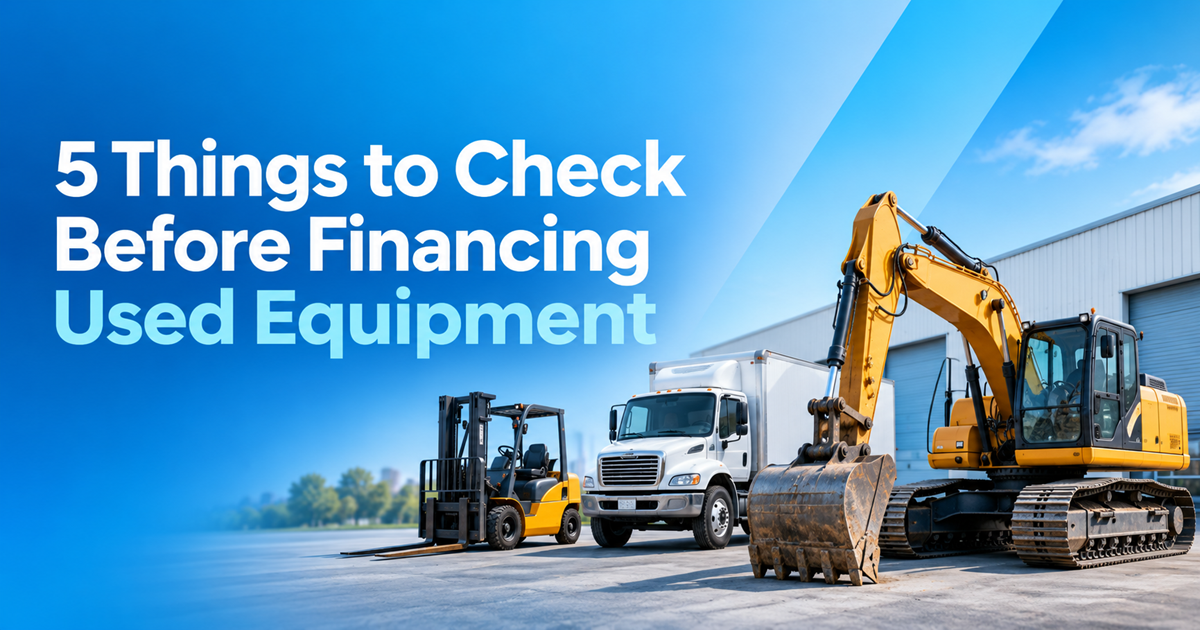
5 Things to Check Before Financing Used Business Equipment in Australia
Buying brand-new equipment isn't always practical for a small business.
Maybe you're a tradie looking for a second-hand forklift, a construction contractor considering used machinery or a business owner planning to replace an ageing piece of equipment.
Buying used can reduce the upfront purchase price. However, a lower price doesn't always mean a better deal.
An older machine might need expensive repairs. The seller may still owe money on it. Or the equipment might not meet a lender's finance requirements.
That's why it's important to do your homework before signing a purchase contract.
Before financing used business equipment in Australia, check the equipment's condition, any existing security interests, lender requirements, total ownership costs and the purchase documentation.
Here are five practical checks to help you make a more informed decision.
1. Check the Equipment's Condition and Service History
The first thing to investigate is the actual condition of the equipment.
A machine may look clean in photographs but still have mechanical issues, excessive wear or a history of breakdowns.
For example, a second-hand forklift may have a reasonable purchase price but require repairs before it can be used reliably.
Similarly, a used excavator might have significant operating hours or maintenance requirements that affect its suitability for your business.
What Should You Inspect?
Depending on the equipment, consider checking:
- Age and model
- Operating hours or usage history
- Available maintenance and service records
- Visible damage, leaks or excessive wear
- Previous repairs or modifications
- Safety features and required inspections
- Availability of replacement parts
Ask the seller whether maintenance records are available.
If the equipment has been used extensively, find out which components have been replaced and whether major repairs may be approaching.
Is an Independent Inspection Worth It?
For valuable machinery, an independent inspection by a suitably qualified technician may help identify issues that aren't obvious during a visual inspection.
This is particularly relevant when purchasing from a private seller or buying equipment you haven't previously operated.
An inspection cannot guarantee that a machine will never develop a fault. However, it can provide useful information before you commit.
Practical tip: Don't choose equipment based only on its advertised price. Consider its condition, expected remaining useful life and the work you need it to perform.
The Australian Government's equipment buying and leasing guide recommends considering quality, repair services and spare-parts availability before purchasing business equipment.
2. Check for Existing Finance or Security Interests
One of the most important checks when buying second-hand business equipment is determining whether someone else has a registered security interest in it.
For example, a seller may be offering machinery that is still subject to a loan.
If you buy the equipment without properly checking the security position, you could face complications after the purchase.
What Is a PPSR Search?
The Personal Property Securities Register (PPSR) is an Australian Government register of security interests in personal property.
It can help buyers identify whether assets such as machinery, vehicles or business equipment are subject to registered security interests.
For a second-hand purchase, the appropriate search may be made using the seller's details or an eligible asset identifier, depending on the type of equipment.
A PPSR search is particularly worth considering when purchasing machinery privately.
How Can You Check Used Equipment?
Before completing the purchase:
- Confirm the seller's identity and business details.
- Record the equipment's make, model and relevant identifying numbers.
- Determine which PPSR search is appropriate for the asset and seller.
- Review the search result for registered security interests.
- Obtain appropriate evidence that any relevant security interest will be discharged before proceeding.
A PPSR search does not prove that the seller owns the equipment, and a clear result does not guarantee that every possible legal issue has been resolved.
If a security interest appears, seek appropriate advice about the next steps.
You can conduct searches through the official Australian PPSR website.
Why Does This Matter for Equipment Finance?
Lenders may need to understand the ownership and security position of the asset before providing finance.
If the asset has unresolved security interests or ownership issues, that may affect the purchase and proposed financing arrangement.
Uniko Capital's equipment finance service also recommends PPSR checks for valuable second-hand machinery.
Practical tip: Complete the appropriate legal and security checks before paying for valuable used equipment, especially through private sales.
3. Check Whether the Equipment Meets Lender Requirements
Finding a suitable machine doesn't automatically mean you'll be able to finance it.
Lenders have their own requirements for the types of equipment they are willing to fund.
For example, a lender may consider the age, condition, value and intended use of a second-hand asset.
Some lenders may apply different conditions to equipment purchased privately compared with equipment supplied by an established dealer.
What Might a Lender Consider?
Depending on the application, lenders may review:
- Equipment type and age
- Purchase price and assessed value
- Seller or supplier information
- Equipment condition and identifying details
- Your ABN and business trading history
- Business income and existing financial commitments
- Available deposit
- Proposed loan term and repayment capacity
Not every lender applies the same criteria.
A finance option available for one piece of machinery may not be suitable for another.
Should You Arrange Finance Before Buying?
It can be useful to speak with a finance broker before signing a binding purchase agreement.
This allows you to understand which finance options may be available and what documents a lender is likely to request.
For example, you might find a second-hand machine at an auction.
Before bidding, it is worth confirming the auction's payment conditions and whether your financing arrangements can meet those deadlines.
Remember that finance pre-approval, where available, is generally conditional and should not be treated as a guarantee of final approval.
At Uniko Capital, business owners can explore finance arrangements for eligible new and used business assets.
Its Asset & Equipment Finance service covers machinery, tools, agricultural equipment, construction plant and other eligible assets, subject to lender assessment.
4. Calculate the Total Cost, Not Just the Purchase Price
A cheaper machine isn't always cheaper to own.
When buying used equipment, you need to consider what it will cost to finance, operate and maintain over time.
For example, imagine two businesses considering the same type of machinery.
One chooses a newer machine with a higher purchase price and lower expected early maintenance needs.
The other chooses an older machine at a lower price but later faces significant repair costs.
The better financial decision depends on the actual equipment, operating requirements and total costs.
What Costs Should You Include?
When preparing your budget, consider:
- Equipment purchase price
- Loan interest and finance fees
- Deposit and repayment amounts
- Insurance
- Transport and delivery
- Servicing and maintenance
- Replacement parts and repairs
- Operating costs
- Relevant inspections and compliance expenses
Also consider what happens if the equipment becomes unavailable for work.
For businesses that rely on machinery to complete jobs, downtime may affect their ability to meet customer commitments.
Understand the Finance Structure
Business equipment finance may be arranged through different products, including equipment loans, chattel mortgages, finance leases or hire purchase agreements.
Their ownership arrangements, payment obligations and end-of-term conditions can differ.
For example, certain finance arrangements may include a balloon or residual amount payable at the end.
This can reduce regular repayments while leaving a larger final payment to manage.
Before signing, review the total amount payable and any end-of-term obligations.
Can Equipment Finance Help Manage Cash Flow?
Finance may allow an eligible business to spread the purchase cost rather than paying the full amount upfront.
However, the benefit depends on the repayment structure and your business's financial position.
Regular repayments remain a commitment even during slower trading periods.
Prepare a cash flow forecast and consider whether your business could manage repayments alongside operating costs.
If you're unsure which finance structure is appropriate, Uniko Capital can help you compare relevant options through its equipment finance service.
5. Review the Purchase Documents and Tax Considerations
The final check is making sure the purchase and finance paperwork is accurate.
Before committing, confirm that the equipment details match the item you have inspected.
What Documents Might You Need?
Depending on the seller, equipment and lender, relevant documents may include:
- Purchase quotation or invoice
- Seller's details
- Equipment description and identifying numbers
- Service and inspection records
- Appropriate PPSR search results
- Evidence relating to existing security interests
- Business identification and ABN details
- Financial information requested by the lender
Make sure the price, equipment description and sale conditions are clear.
If you're buying from a private seller, you may need additional documents to establish the transaction details and satisfy lender requirements.
What About GST and Depreciation?
Business equipment purchases can have GST and income tax implications.
However, the treatment depends on factors including your business's GST registration, the seller, the type of purchase, business use and the finance agreement.
For example, the accounting treatment of a chattel mortgage can differ from that of a finance lease.
Eligible businesses may also be able to claim deductions relating to depreciating assets, subject to the rules applicable in the relevant income year.
The fact that equipment is second-hand does not, by itself, establish which deductions are available.
Don't assume a purchase is automatically tax-deductible or that you will receive a particular GST credit.
Speak with your accountant or registered tax adviser before making decisions based on potential tax benefits.
Check Your Finance Agreement
Before signing the finance documents, make sure you understand:
- Loan term and repayments
- Interest rate and fees
- Security requirements
- Ownership arrangements
- Early repayment conditions
- Any final balloon or residual payment
Ask questions about anything you don't understand.
Quick Checklist Before Financing Used Business Equipment
| Check | What to confirm |
|---|---|
| Equipment condition | Age, operating hours, service history and physical condition |
| PPSR and seller checks | Relevant registered security interests and sale authority |
| Lender requirements | Asset eligibility, finance documents and repayment capacity |
| Total costs | Interest, fees, insurance, maintenance and repairs |
| Documentation | Purchase agreement, equipment details, tax and finance conditions |
This checklist can be used when comparing a second-hand forklift, excavator, manufacturing machine or another eligible business asset.
Is Used Equipment Finance Available for Small Businesses in Australia?
Potentially, yes.
Some lenders offer finance for eligible used machinery and equipment, depending on the asset and applicant.
For example, businesses may explore finance for:
- Construction and earthmoving equipment
- Forklifts and materials-handling machinery
- Agricultural equipment
- Manufacturing machinery
- Commercial kitchen equipment
- Trade equipment
- Other eligible business assets
Lender requirements differ based on equipment age, value, condition and intended use.
Business trading history, credit information and repayment capacity may also influence the available options.
If you're a self-employed contractor or small business owner, you may need to supply additional documents demonstrating business income and financial commitments.
Uniko Capital assists eligible Australian businesses with equipment finance enquiries, including applicants purchasing used assets.
Should You Buy New or Used Equipment?
There isn't one option that suits every business.
New equipment may provide access to current technology, manufacturer warranties and a known usage history.
Used equipment may offer a lower purchase price or provide an opportunity to acquire a suitable machine without purchasing the latest model.
However, second-hand assets may require more detailed condition checks and could have different maintenance costs.
The decision should depend on:
- Your business requirements
- The type of equipment
- Expected usage
- Available budget
- Maintenance requirements
- Equipment availability
- Suitable finance options
For businesses considering construction machinery, Uniko Capital also has an existing guide to excavator financing in Australia.
How Can an Equipment Finance Broker Help?
Comparing equipment finance can be more difficult when the asset is second-hand.
Different lenders may have different requirements concerning its age, value, condition and seller.
A finance broker can help you understand which lenders may consider the proposed purchase and explain relevant finance structures.
Uniko Capital is a Melbourne-based finance broking business assisting Australian business owners, tradies, contractors and self-employed applicants.
Its equipment finance service includes guidance on eligible machinery, business assets and commercial equipment.
The team can help you understand potential lender requirements, compare applicable finance terms and prepare an application for assessment.
Final loan approval remains subject to the lender's credit criteria and conditions.
Explore Used Equipment Finance Options with Uniko Capital
Used equipment can be a practical option for businesses that need machinery without committing to the cost of a brand-new asset.
But it's important to understand what you're buying and how the finance arrangement will affect your business.
Checking the equipment, reviewing security interests, comparing total costs and preparing your documents can help you make a better-informed decision.
Uniko Capital assists Australian businesses with exploring finance for eligible new and used equipment.
Looking to Finance Used Business Equipment?
Uniko Capital Pty Ltd
Australian Credit Licence: 577377
Head Office: Suite 304, 111 Overton Road, Williams Landing VIC 3027
Phone: 1300 086 456
Email: admin@unikocapital.com.au
Website: www.unikocapital.com.au
Disclaimer: This article provides general information only and does not constitute personal financial, credit, tax or legal advice. Equipment finance availability, eligibility, rates and conditions depend on lender assessment and individual circumstances. Seek independent professional advice where appropriate before entering into a purchase or finance agreement.
Frequently Asked Questions
Can I get finance for second-hand business equipment in Australia?
Yes, some lenders offer finance for eligible second-hand business equipment. Approval depends on factors including the asset's age, value, condition and the applicant's financial circumstances.
What should I check before buying used machinery?
Check the machine's condition, service history, operating hours, available parts, safety requirements, relevant security interests and expected maintenance costs.
Do I need a PPSR check before buying used equipment?
A PPSR search is an important precaution for valuable second-hand assets. It may help identify registered security interests, but it does not confirm legal ownership or replace other purchase checks.
Is used equipment finance available for self-employed people?
Eligible self-employed applicants may be able to access equipment finance. Lenders may review ABN history, income, bank statements, existing debts and repayment capacity.
Is buying used business equipment tax-deductible?
Tax treatment depends on the business, asset, finance arrangement and applicable tax rules. Speak with your accountant about depreciation, GST and any available deductions.