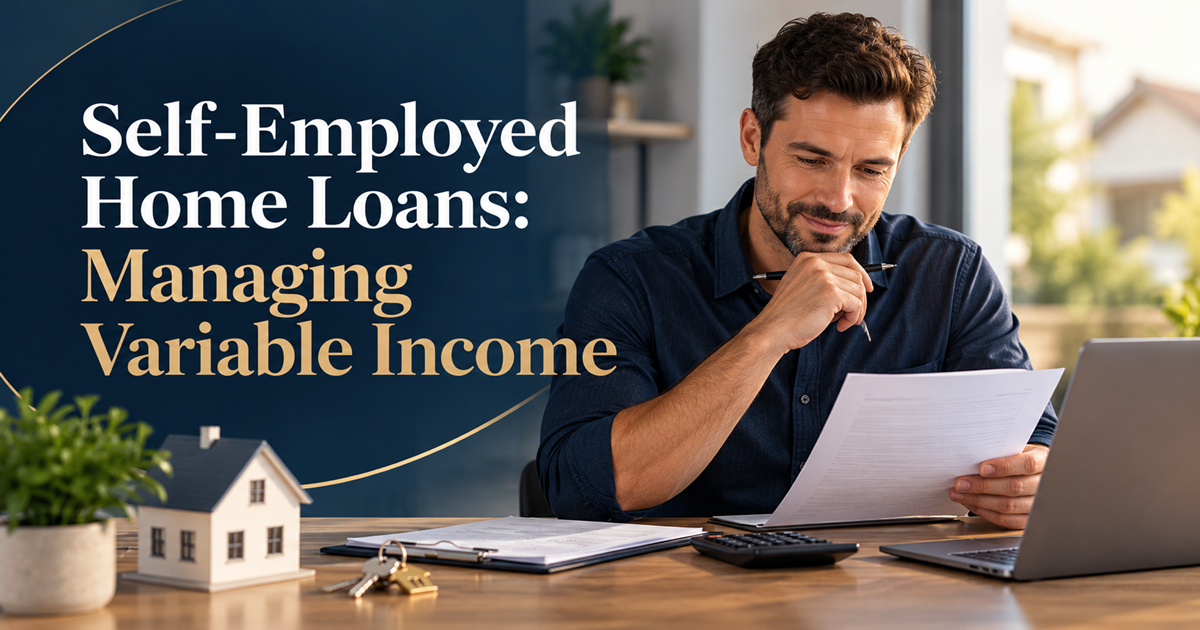
Self-Employed Home Loans in Australia: What If Your Income Changes Every Month?
Running your own business gives you flexibility, but it can make applying for a home loan feel more complicated.
One month might bring plenty of work and strong income. The next could be quieter, especially if you're a contractor, tradie or business owner working on seasonal projects.
So, what happens when you apply for a mortgage without a regular salary?
Self-employed Australians can qualify for home loans, even when their income varies. The main difference is how lenders assess and verify that income. Instead of relying mainly on payslips, they may review tax returns, business financial statements, bank statements and other supporting records.
If you're exploring self-employed home loans in Australia, understanding this process can help you prepare before approaching a lender.
Can You Get a Home Loan If You're Self-Employed?
Yes. Being self-employed doesn't automatically prevent you from getting a home loan.
Whether you're a sole trader, contractor, company director or small business owner, lenders will want to understand your financial position and ability to make repayments.
The assessment may be different from that of someone receiving a regular PAYG salary.
For example, an employee might provide payslips showing a consistent fortnightly income. A business owner may need to demonstrate how much income the business generates, what expenses it pays and how much income is available to support mortgage repayments.
Lenders may also look at your deposit, existing debts, living expenses, credit history and the property being purchased.
At Uniko Capital, self-employed borrowers can explore home loan options based on their income structure and financial circumstances.
How Do Lenders Assess Irregular Self-Employed Income?
If your business income changes throughout the year, lenders generally need to determine what level of income can reasonably support your loan repayments.
1. Business Income and Profit
Your total business revenue isn't necessarily the amount a lender will treat as your personal income.
For example, a business might receive $20,000 in customer payments during a month but also have substantial expenses for materials, wages, equipment and other operating costs.
Lenders need to understand the difference between business turnover and the income available to support the loan.
Depending on your business structure, they may assess taxable income, financial statements and other supporting information.
2. Income Over Different Financial Periods
Some lenders review more than one financial year to understand how your business has performed.
They may consider whether income has been relatively consistent, increased or declined.
If your income varies because of seasonal work or project-based contracts, providing clear records can help explain those changes.
However, lenders apply different methods when assessing self-employed income. A strong recent month doesn't necessarily mean they'll use that amount to calculate your annual borrowing capacity.
3. Existing Business and Personal Commitments
Your financial commitments also affect borrowing capacity.
These may include business loans, equipment finance, credit cards, existing mortgages and regular household expenses.
A lender will want to see whether you can manage a new home loan alongside your existing obligations.
This is why a business with strong revenue may still face borrowing limitations if it has substantial ongoing expenses or debts.
What Documents Do Self-Employed Borrowers Need for a Home Loan?
The documents required will depend on the lender, your business structure and the type of home loan you're applying for.
Common requirements may include:
- Personal identification
- ABN and business details
- Personal and business tax returns
- ATO Notices of Assessment
- Profit and loss statements
- Business bank statements
- Business Activity Statements (BAS)
- Details of existing loans and liabilities
- Evidence of savings or deposit
- Information about the property
Not every applicant will need every document on this list.
Some lenders use different income-verification methods, particularly for eligible borrowers applying through alternative-documentation pathways.
Preparing the records available to you before applying can help make the assessment process more straightforward.
What If You Don't Have Two Years of Financial Statements?
This is a common concern for business owners who have recently become self-employed or changed the way their business operates.
While some lenders prefer an established trading history and multiple years of financial records, other lenders may consider different documentation arrangements.
The options depend on the lender's criteria, your business circumstances and your ability to demonstrate income.
For some eligible applicants, alternative-documentation home loans may be worth exploring.
What Is a Low-Doc or Alt-Doc Home Loan?
A low-documentation or alternative-documentation home loan allows eligible borrowers to provide different types of income evidence instead of the standard set of financial statements or tax returns.
Depending on the lender, this may include BAS records, business bank statements or an accountant's letter.
However, a low-doc home loan doesn't mean income verification is unnecessary.
Lenders still need to assess your financial situation and repayment capacity.
Alternative-documentation loans may also have different interest rates, fees, deposit requirements or other conditions.
Before applying, compare the available options carefully.
You can explore home loan solutions for self-employed borrowers through Uniko Capital.
Does Your Business Structure Affect a Home Loan Application?
It can.
Different business structures may require different financial documents to establish the income available to you.
Sole Traders
If you're a sole trader, your business income is generally reported through your individual tax return.
Lenders may review your declared income, business expenses and supporting financial records.
Company Directors
If you operate through a company, lenders may examine your salary, company financial statements and other relevant income arrangements.
The assessment will depend on how you receive income from the business and the lender's policies.
Contractors
Contractors may receive payments from different clients or work on agreements with varying durations.
Lenders may consider the nature of the contracting arrangement, income history and supporting documentation.
The important thing is having records that accurately explain how you earn your income.
How Can You Prepare Before Applying for a Self-Employed Home Loan?
A little preparation can help you understand your position before making an application.
1. Review Your Financial Records
Check that your available tax returns, bank statements and business records are accurate and reasonably up to date.
If you're unsure which documents are relevant, speak with your accountant or mortgage broker.
2. Understand Your Monthly Commitments
Look at your existing business and personal repayments.
Consider how a new mortgage would affect your household budget, particularly during quieter business periods.
3. Check Your Deposit and Savings
The deposit required depends on the property value, loan type and lender requirements.
A larger deposit may reduce the amount you need to borrow and may affect lender's mortgage insurance requirements.
However, the deposit alone doesn't determine whether a loan will be approved.
4. Compare More Than the Interest Rate
When assessing home loans for self-employed borrowers, look at the full loan cost.
This includes the interest rate, comparison rate, establishment fees, ongoing charges and repayment terms.
You should also consider whether features such as an offset account, redraw facility or flexible additional repayments are useful for your circumstances.
An option with a lower advertised interest rate may not necessarily have the lowest overall cost.
5. Speak With a Mortgage Broker
Different lenders have different approaches to assessing self-employed income.
A mortgage broker can help explain the available options, identify the documents you may need and compare loan terms.
If you're unsure where to begin, speaking with a broker before submitting an application may help you understand which lenders' criteria are relevant to your circumstances.
Why Might Self-Employed Borrowers Use a Mortgage Broker?
Applying for a home loan can involve more documentation when your income comes from a business rather than a regular salary.
A mortgage broker can help you understand how lenders assess your income and compare available products.
This may be particularly useful if:
- Your monthly income changes significantly.
- You've recently started or restructured your business.
- You operate as a sole trader or company director.
- You have business loans or equipment finance.
- You want to understand alternative-documentation options.
- You're looking to buy a property or refinance an existing mortgage.
Uniko Capital is a Melbourne-based finance broking business assisting self-employed Australians, tradies, contractors and business owners.
Its services include home loans, business finance and other lending options for eligible borrowers.
The team can help review your financial circumstances, discuss available lender requirements and explain loan features and costs before you decide whether to proceed.
Can You Refinance a Home Loan If Your Income Is Irregular?
Potentially, yes.
Self-employed homeowners may be able to refinance, provided they meet the new lender's assessment requirements.
The lender will generally review your current income, expenses, debts, credit history and property value.
If your income has changed since you obtained your original mortgage, it may affect your refinancing options.
You should also compare the costs of switching, including discharge fees, application fees and any fixed-rate break costs.
For a better understanding of loan terminology, read our guide on the difference between a mortgage and a home loan.
Explore Your Home Loan Options with Uniko Capital
If you're self-employed and planning to buy a home or refinance, irregular income doesn't automatically mean a home loan is out of reach.
The important step is understanding how lenders assess your finances and what documentation may be required.
Uniko Capital helps self-employed Australians compare home loan options based on their circumstances and financial goals.
Speak With a Home Loan Broker Today
Uniko Capital Pty Ltd
Australian Credit Licence: 577377
Head Office: Suite 304, 111 Overton Road, Williams Landing VIC 3027
Phone: 1300 0 UNIKO
Website: www.unikocapital.com.au
Disclaimer: This article provides general information only and does not constitute personal financial, credit, tax or legal advice. It does not take into account your individual objectives, financial situation or needs. Home loan availability, interest rates, fees and approval are subject to lender criteria and assessment. Consider obtaining professional advice before making a borrowing decision.
Frequently Asked Questions
Can I get a home loan in Australia without regular payslips?
Yes, eligible self-employed borrowers may be able to obtain a home loan without regular PAYG payslips. Lenders generally require other evidence to assess income and repayment capacity.
Do I need two years of tax returns for a self-employed home loan?
Some lenders request two years of financial information, while others may consider a shorter history or different documentation. Requirements depend on the lender and your circumstances.
Can I apply for a home loan with an ABN?
Having an ABN may support your application, but an ABN alone doesn't establish home loan eligibility. Lenders also assess income, financial commitments, credit history and repayment capacity.
Are low-doc home loans available in Australia?
Yes. Some lenders offer alternative-documentation home loans for eligible borrowers. These still require income verification and may have different fees, interest rates and lending conditions.
Does inconsistent income mean my home loan will be rejected?
Not necessarily. Lenders assess your overall financial position and supporting evidence. The outcome depends on whether you meet the lender's requirements.
Can Uniko Capital assist self-employed home loan applicants?
Yes. Uniko Capital assists eligible self-employed borrowers with understanding home loan requirements, comparing lending options and preparing applications.